
Beyond Metrics. Sustainability is the Strategy.
The Strategic Advisor ensures the industry is not just competitive today-but ready for tomorrow
Long-Term Growth
Market Positioning
Operational Efficiency
Sustainability
We, Strategic Advisor, are senior-level expert who provides high-level guidance to a company’s leadership—often the Chairman, MD, Board of Directors, or CXO Team—on long-term growth, market positioning, operational efficiency, and sustainability. Unlike operational managers, they don’t usually execute day-to-day tasks but focus on shaping decisions that influence the company’s future direction.
Industry Core Shift for the Next Decade
We architect integrated Services, Systems, and Solutions that reposition industry players into a resilient, diversified, and technology-enabled ecosystem—where sustainability becomes a strategic advantage, not an obligation.
Our mandate is clear: to enable the textile and apparel industry to consistently deliver high-value products, achieve margin-accretive growth, and earn enduring global trust in an increasingly competitive world
Value
From Volume → Value
System Advantage
From Cost Advantage → System Advantage
Competitive Sustainability
From Compliance → Competitive Sustainability
Positioning Bangladesh for the Next Decade of Textile Excellence
By the next decade, Bangladesh’s textile and apparel industry will evolve into a diversified, resilient, and high-value ecosystem—delivering sustainable efficiency, enhanced productivity, stronger profitability, and enduring global trust.
This roadmap defines the industry’s next transformation cycle: transitioning from a labor-cost advantage to a technology-enabled, sustainability-driven, and margin-resilient growth model.
The sector is entering its second strategic evolution phase—shaping a scalable, ESG-aligned, and margin-expanding industrial ecosystem through structured modernization and innovation.
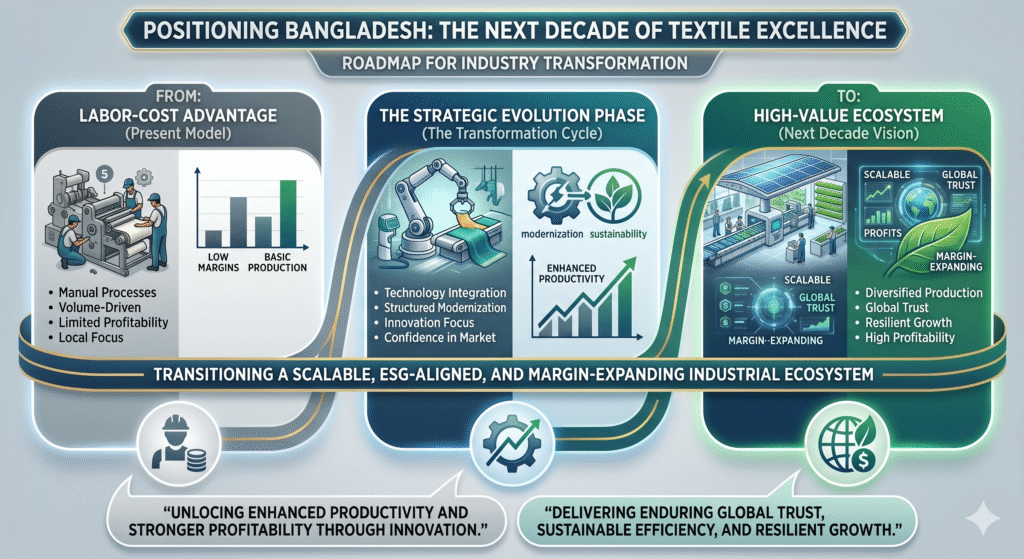
Our endeavor is to accelerate this transformation journey—enabling industry players to gain momentum, strengthen competitiveness, and lead with confidence in the global marketplace.
Role of the Strategic Advisor
Role of the Strategic Advisor
It’s just as important to be clear about this:
- Acts as a trusted sounding board for leadership.
- Provides independent, objective insight on business challenges and opportunities.
- Helps the company align resources, capabilities, and markets for sustainable growth.
- Supports in navigating market complexity, competition, and industry shifts.
Duties and Responsibilities of the Strategic Advisor role based
Strategic Planning
- Analyze industry trends, competition, and emerging opportunities.
- Advise on long-term vision, business models, and corporate strategy.
- Recommend priorities for growth, diversification, or restructuring.
Market and Business Insight
- Provide guidance on entering new markets or segments.
- Identify potential risks and mitigation strategies.
- Advise on pricing, positioning, and competitive advantage.
Decision Support
- Offer unbiased evaluations of major investment, partnership, or M&A decisions.
- Help leadership evaluate trade-offs between growth, cost, and risk.
- Guide on resource allocation and capability development.
Network and Relationships
- Introduce strategic contacts, partners, investors, or clients.
- Facilitate collaborations or alliances that support company objectives.
Governance & Risk Advisory
- Provide insights on corporate governance and compliance.
- Anticipate potential regulatory, market, or reputational risks.
Performance Measurement
- Suggest objectives and key results (OKR) aligned with long-term objectives.
- Evaluate business performance beyond just financial metrics.
How We do work with the Company
- Engagement Style: Usually advisory role based retainer, attending board or strategy meetings periodically.
- Collaboration: Works closely with Board of Directors & C-suite executives but does not usually interfere with operational execution.
- Reporting: Provides strategic recommendations and structured advice through presentations, memos, or workshops
- Integration: Ensures that strategic initiatives are aligned with the company’s culture, capabilities, and market realities.